You’ve checked in online, your documents are sorted, and you’ve arrived at the airport on time. That part was the preparation. Now you’re inside the terminal and a different kind of overwhelm sets in.
The signs are everywhere. There are queues you don’t recognise. Someone in uniform is directing people and you’re not sure if that applies to you. Another passenger tells you to follow them but you’re not sure if they’re going to the same place.
First-time flyers in Nigeria, especially at MMIA Lagos, Nnamdi Azikiwe Abuja, or Port Harcourt International, often know what to do before they arrive and then freeze once they’re actually inside. The terminal environment is unfamiliar. The stakes feel high. And there are real mistakes you can make that have serious consequences.
This guide walks you through exactly what to do at each stage inside the terminal, and what to absolutely avoid.
Quick Summary
- Once you’re inside the terminal, follow the signs in sequence: check-in, then immigration (for international flights), then security screening, then your gate.
- Keep your passport and boarding pass in your hand at every checkpoint. Don’t pack them inside your bag after each stop.
- At security, remove your belt, laptop, phone, and anything in your pockets before you get to the conveyor. Don’t wait until you’re at the machine.
- Never carry a bag or parcel for someone else, no matter who asks or how they explain it. This is not an exaggeration.
- Once boarding is announced, stay near your gate. Don’t wander off to buy something. Flights do leave without passengers.
The Sequence Inside the Terminal: Know It Before You Walk In
The terminal process has a fixed order. Understanding the sequence in advance removes most of the confusion.
For international departures, the order is:
- Check-in and baggage drop (if you haven’t done it online, or if you have checked luggage)
- Departure tax / airport levy payment (some airports require this at a separate counter before immigration, check at check-in)
- Immigration clearance (Nigerian passport control, where your passport is stamped for departure)
- Security screening (bags through the X-ray machine, you through the body scanner)
- Airside area and gate (where you wait to board)
For domestic departures, it’s simpler:
- Check-in and baggage drop
- Security screening
- Gate
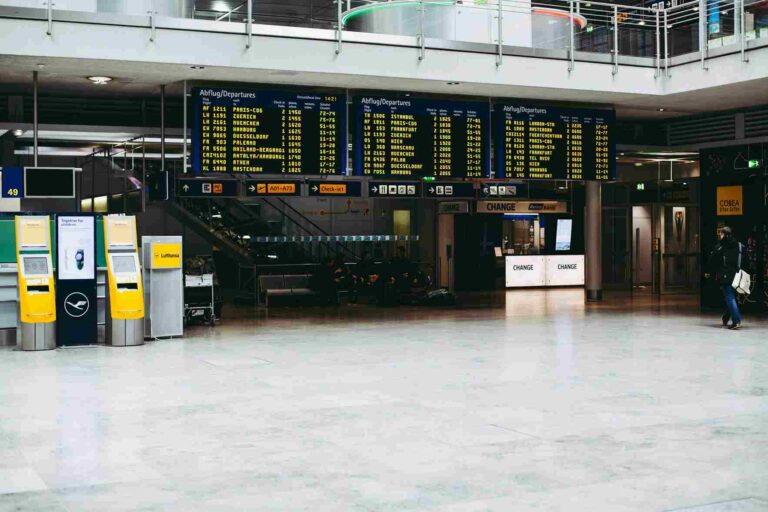
Each stage has signs pointing to the next one. Follow them in order. If you’re unsure which queue you’re in, ask an airport staff member with a visible ID badge, not a random person who approaches you offering help.
At Check-In: What to Have Ready
If you’re doing check-in at the counter rather than online, have these ready before you reach the agent:
- Passport (open to the photo page)
- Boarding pass if you checked in online, or your booking reference if you haven’t
- Visa or entry document for your destination
- Yellow card if your destination requires it
The agent will weigh your checked bag, tag it, and send it onto the belt. Watch them attach the tag to your bag and confirm the destination code on the tag matches your destination. It’s a small thing but bag mislabelling does happen.
After check-in, you’ll get a boarding pass if you didn’t have one, or it’ll be confirmed if you checked in online. Keep this boarding pass accessible for every subsequent checkpoint. Don’t put it at the bottom of your bag.
At Immigration: Don’t Rush, Don’t Joke Around
For international departures, after check-in you’ll go through Nigerian immigration. This is where an officer reviews your travel documents and stamps your passport for departure.
What to have ready:
- Passport
- Boarding pass
- Sometimes your return ticket or hotel booking, though this is more common on arrival at your destination
The process is usually straightforward. Hand over your documents, answer any basic questions (where are you going, how long), receive your stamped passport back, and move on.
A few firm rules here:
- Do not make jokes about anything security-related. Ever. Not about bombs, not about weapons, not about anything. Immigration officers have zero tolerance and no sense of humour about it.
- Do not argue aggressively with an officer even if you think they’re being unreasonable. If something isn’t right, stay calm and ask to speak to a supervisor.
- Do not hand over your documents to anyone who isn’t in uniform at an official counter. People do approach travellers in the terminal offering to “help” them through immigration faster. This is not a legitimate service.
At Security Screening: Prepare Before You Reach the Belt
Security is where most first-time travellers slow down unnecessarily, not because they have anything wrong, but because they’re not prepared for the process.
Here’s what will happen: your carry-on bags go through an X-ray machine on a conveyor belt. You walk through a body scanner or metal detector. If anything sets off an alarm, a security officer will do a physical pat-down or use a handheld scanner.
What to do before you reach the front of the queue:
- Remove your laptop or tablet from your bag and place it in a separate tray
- Remove your belt, watch, keys, coins, and anything in your pockets and put them in a tray
- Remove your shoes if instructed (some airports require this, some don’t)
- Make sure your liquids bag (100ml containers in a clear bag) is accessible and can be removed from your carry-on quickly if asked
Don’t wait until you’re at the machine to start doing all this. The person behind you is watching and the queue backs up fast.
Once you’re through, collect everything from the trays before you move. Double-check that your passport, boarding pass, phone, and wallet all came through with you. People leave things in the trays more often than you’d think, especially when they’re nervous.
What You Must Never Do Inside a Terminal
These aren’t just tips. Some of these have real legal and safety consequences.
Never carry a bag or parcel for someone else. This is the most important point on this list. It doesn’t matter if the person is your auntie’s church member, a fellow Nigerian who seems friendly, or someone who looks completely harmless. If they put drugs, cash, contraband, or anything illegal in that bag, you are the one carrying it through security and you are the one who gets arrested. “I didn’t know what was in it” is not a legal defence in most countries. Refuse, always.
Never pack prohibited items and hope they go unnoticed. Sharp objects, excess liquids, certain electronics, and obviously illegal items will be detected by X-ray. If it’s confiscated, you lose it. If it’s serious, you could be detained. The list of prohibited items is on your airline’s website. Read it before you pack.
Never leave your bags unattended anywhere in the terminal. An unattended bag in an airport is treated as a security threat. It can be seized, destroyed, or cause an evacuation. Keep your carry-on with you at all times. If you need to use the bathroom, take it with you.
Never ignore gate announcements. Once you’re airside (past security), listen for your flight’s boarding call. It will include your flight number and gate number. If you’re not sure which gate is yours, check the departure board, it’s updated in real time.
Never wander far from your gate once boarding has started. Airlines will not delay a flight to find a passenger who wandered off. Final boarding calls are made once, maybe twice. After that, the gate closes. If you miss it, the flight leaves without you and getting a replacement seat can be expensive.
What Happened to Emeka’s Neighbour
Emeka was flying to London for the first time. At the airport, a man he’d never met came up to him near the check-in hall, said he was also travelling to London, and asked if Emeka could carry a small package for his sister who would collect it on the other side. “It’s just some food and a few items,” the man said. “My bag is already full.”
Emeka said no. He didn’t explain himself. He just said no and walked away.
He doesn’t know if the man was genuine or not. He doesn’t need to know. The answer to that request is always no.
That’s the correct response. No matter how the request is framed.
At Your Gate: How to Wait Without Missing Your Flight
Once you’re past security and at the right gate, the hardest part is over. But a few things still matter.
Check the departure board when you arrive at the gate. Gates do change, sometimes close to departure. If your boarding pass says Gate C4 but the board now shows Gate C7 for your flight, go to C7.
Listen for announcements. Boarding usually starts 30 to 45 minutes before departure. They’ll call by rows or seat zones. When your zone is called, join the queue. Don’t rush to join the first group if your zone hasn’t been called, it just creates congestion.
Have your boarding pass and passport accessible, not buried in your bag. You’ll need to scan your boarding pass at the gate and sometimes show your passport again.
If you need to use the bathroom or buy something after security, do it immediately after you get through, before you sit down at the gate. Don’t go looking for a shop when boarding is already being announced.
FAQs
What do I do if I can’t find my gate? Look at the departure board in the airside area. It lists all flights, their status, and their gate numbers in real time. If you’re still unsure, ask any airport staff member in a visible uniform. Don’t ask other passengers for directions if you can help it because they may be just as lost as you are.
What happens if my carry-on is flagged at security? Stay calm. The officer will either run it through the machine again or open it for a manual check. This is routine and doesn’t mean you’ve done anything wrong. Answer questions honestly and straightforwardly. If something is flagged that you don’t understand, ask for an explanation before they remove anything.
Can I use my phone during security screening? Put your phone in a tray before you walk through the scanner. Don’t hold it in your hand as you go through. After you’re through, collect it from the tray and you can use it freely once you’re past the checkpoint.
What do I do if I miss my boarding call? Go to your gate immediately and explain to the gate agent that you’re there for the flight. If boarding hasn’t fully closed, they may still let you through. If the gate is closed, go back to the airline’s check-in desk or customer service counter as quickly as possible. Options at that point depend on the airline, whether there’s a later flight, and how much the rebooking costs. It won’t be free.
Someone is offering to help me “skip the queue” at immigration or security for a fee. Is this legitimate? No. There is no legitimate pay-to-skip service at Nigerian airport immigration or security queues. Anyone offering this is either running a scam or facilitating something you don’t want to be part of. Decline and report it to an airport security officer if the person is persistent.
Stay Calm, Follow the Signs, and Trust the Process
The terminal can feel overwhelming the first time. But the process is designed to be linear. You follow one step to the next. The signs are there. The staff are there to direct you if you’re lost.
What gets first-time travellers into trouble is panic, rushing, and trusting the wrong people. None of that is necessary if you know what to expect.
If you’re preparing for your first international trip as part of your japa journey, the airport is just the beginning. DeyWithMe has guides covering everything from visa applications to settling in abroad, built specifically for Nigerians at every stage of relocation.